
Myelination
Myelin is a fatty substance that insulates the axons of many neurons. Although this may seem like an insignificant structure at first glance, this is not the case at all. Myelin allows an axon to transmit signals at a fast rate. Axons without myelin may be at a disadvantage because these signals travel much slower or may stop altogether. However, it is important to note that not all axons need to be myelinated, and that fact that a large number of axons may not be myelinated does not neccesarily indicate a defect. Afterall, if all signals were transmitted at the same speed, it would create great confusion so it is perfectly fine to have some signals come after other ones.
- Myelin is composed of lipid and protein.
- Myelin appears to be white and therefore is the central component of white matter.
.jpg)
Electrical impulses are transmitted in one direction and these signals pass quicker in the presence of the myelin sheath. As the diagram above illustrates, the myelin sheath is broken up into segments and the gaps between these segments are called nodes of Ranvier. When an impulses passes through a myelinated axon, it has the advantage of "jumping" between the nodes of Ranvier, thus speeding up conduction. One way to understand this concept is to view the myelinated axon as a train in which each myelin segment can be represented by a train compartment. When the train is stationary, there are still people moving between compartments and the movement of people represents the transmission of an impulse.
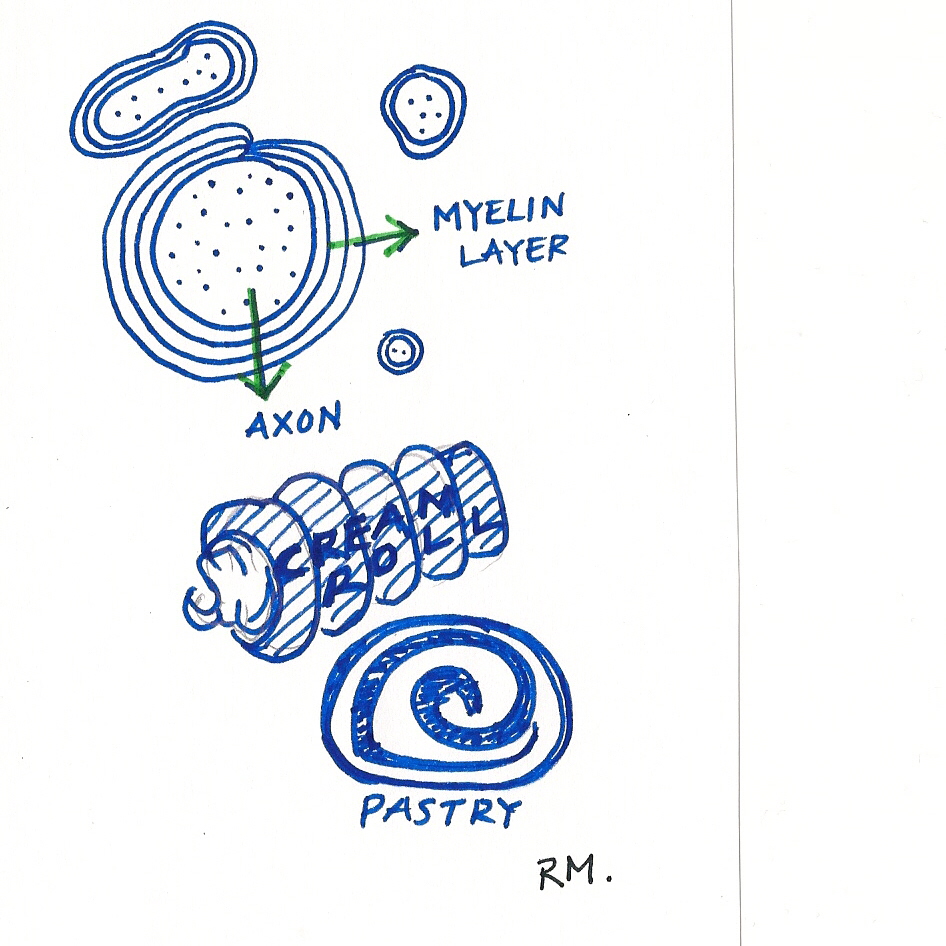
The picture above shows the cross section of a myelinated axon. Overall, axons are circular but can also take other forms such as an ellipse. At high magnification (13500x), clear dots are visibly scattered throughout an axon. These are actually microtubules which support structure. I find it interesting that myelinated axons seem to resemble a cream roll or a pastry in that the filling is surrounded by layers of equal thicknesses. The same can be said of myelinated axons in that each layer of the myelin sheath is normally the same thickness as all the other layers. This is referred to as the periodicity.
Process of Myelination
Myelin can be found in two parts of the nervous system. It can either coat the nerves of the spinal cord or the brain. Oligodendrocytes produce myelin in the CNS whereas another group of glial cells known as Schwann cells produce myelin in the PNS.